Top Affiliate Networks
Ryan Mercer·
Choosing the right affiliate network: a practical comparison for 2026
Picking a network feels like it should be straightforward. It isn't.
The mistake most beginners make is treating network selection as a category decision rather than a business decision. "Which is the best network?" is not a useful question. "Which network gives me the best access to the offer types and commission structures that match how I publish?" is.
The global affiliate marketing industry is valued at $17-18.5 billion in 2025 and projected to surpass $20 billion in 2026, with 81% of advertisers now running affiliate programs. That growth means more options, not fewer. The work is in the selection.
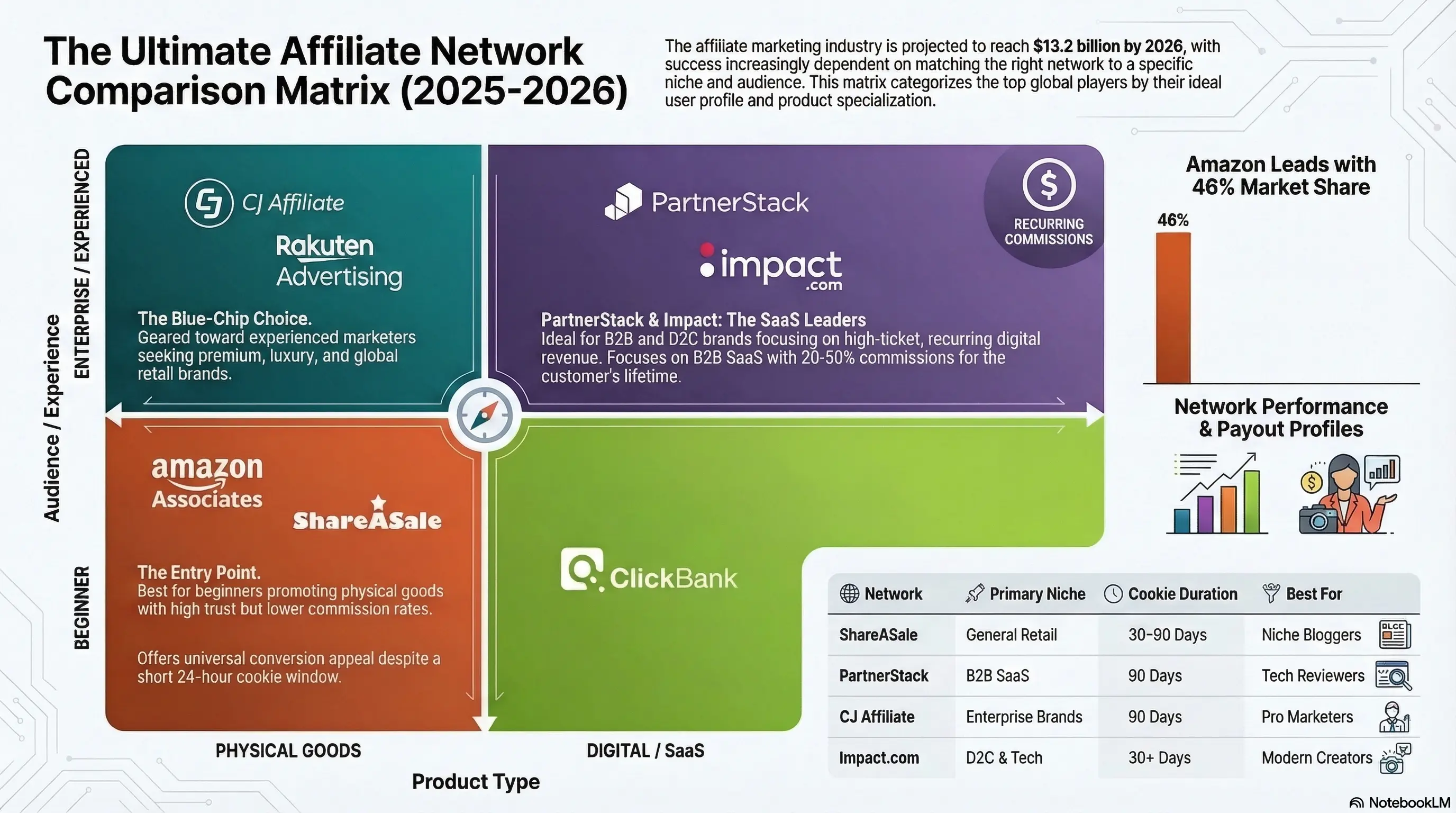
The major networks and what they're actually good for
ShareASale
The starting point for most publishers building their first real affiliate operation. The dashboard is accessible, approval requirements are lower than the enterprise networks, and the brand catalog is broad enough to find relevant offers across most niches.
The tradeoff is that you won't find the highest-commission SaaS offers here, and the tracking and attribution infrastructure is less sophisticated than Impact or CJ. I recommend ShareASale for new affiliates who need to build a track record and test their first offers without jumping through enterprise approval hoops.
CJ Affiliate (Commission Junction)
CJ is the enterprise standard. It's where large publishers, major media brands, and retailers like Lowe's and Overstock operate. If you have significant reach and want to work with household names, this is the right place.
If you're still building, the approval process will be a ceiling more than a gateway. Don't apply until your numbers support it. A rejected application isn't permanent, but it's easier to build the track record first.
PartnerStack
PartnerStack specializes in B2B SaaS recurring commission models. If your niche involves recommending software to other businesses (project management, CRM, marketing automation, analytics), this is where the recurring commission programs concentrate. It's where I'd start for anyone serious about the infrastructure affiliate model. The deal structures favor long-term partnerships in a way that general networks don't.
Impact
Impact is the power option for direct-to-consumer and premium SaaS, with commission ranges of 10-50% common. It also has more flexibility in deal structures; you can negotiate custom rates in ways that ShareASale and CJ typically don't allow.
The tradeoff is that approval and onboarding is slower and the relationship is more managed. The managed relationship pays off once your traffic justifies the attention.
Admitad
Admitad is social-media-first and notably flexible about what counts as a promotional property. You don't need a traditional website to get approved, and high-ticket SaaS offers at 50% commission exist in their catalog. Consider it if you're building an audience on platforms other than a blog or YouTube channel.
Niche payout benchmarks
These are current industry averages for active affiliates at the top of each category. Think of them as directional signals rather than expectations:
- E-learning affiliates: $15,551/month average
- Travel affiliates: $13,847/month average
- Finance affiliates: $9,296/month average
Five things to verify before committing to a network
Most affiliates pick networks based on brand name or commission percentage. Both are useful proxies, but neither tells you whether the network will actually work for your specific publishing model.
1. Cookie duration
Amazon's 24-hour window is a genuine structural problem for YouTube affiliates and long-form content publishers. If your audience takes a week to decide after reading your recommendation, a 24-hour cookie means you're doing the work for free. Prioritize 30-day minimums for high-ticket offers. I've turned down otherwise solid offers because the cookie window made the economics unworkable for the content format I was running.
2. Payout thresholds and speed
Cash flow matters. Networks that pay weekly or bi-weekly are meaningfully different from Net-30 or Net-60 models when you're actively reinvesting in content production. I've been in programs where waiting 60 days for commission payments created real friction. Money I'd effectively already earned was sitting inaccessible while I needed to fund the next content cycle.
3. EPC (Earnings Per Click)
A 50% commission on a product that converts at 0.1% is worse than a 20% commission on a product that converts at 3%. EPC is the number that accounts for both the rate and the conversion. Most networks display average EPC in the offer details. If it's not there, ask before applying.
4. Cross-device tracking attribution
If a viewer discovers your recommendation on mobile and buys three days later on desktop, you need the tracking infrastructure to connect those two events. Not every network handles this equally. Confirm cross-device attribution is supported before building content around an offer. It's one of those details that only becomes obvious after you've lost commissions to it.
5. Recurring vs. one-time structure
One-time commissions require constant acquisition. Recurring commissions build on existing users. At 100-200 active referrals on a 35-70% recurring lifetime commission structure, the math for a $5,000 monthly revenue target looks very different than it does at Amazon's 4% rate on a $50 product.
Why infrastructure changes the network math
The traditional affiliate model requires volume: find a popular product, rank for it, earn a small commission per sale. Stop producing, and revenue drops.
Infrastructure affiliate marketing changes the model. These are products running core business operations: checkout software, CRM tools, funnel builders. Once a user builds their business around a platform you recommended, they don't switch easily. That stickiness means your commission becomes recurring rather than transactional.
The cross-border angle matters here too. 25% of affiliate transactions are now cross-border. Infrastructure tools that handle currency localization and geo-routing are the only practical way to capture that traffic without building separate funnels for each region.
Compliance as a network access filter
FTC, EU DSA, and UK CMA oversight on affiliate disclosures has intensified. Beyond compliance being the right practice, it's also a filter for network access. Brands are actively offboarding affiliates who create legal exposure.
Being compliance-first gives you access to better offer terms. Some premium programs now require documented compliance practices before approval. I think of it less as an obligation and more as a credential; it narrows the competitive field in your favor.
Mistakes to avoid
- Choosing a network based on commission percentage without checking EPC. High percentages on low-converting offers are worse than modest percentages on well-converting ones.
- Starting on Amazon because it's familiar and staying there because switching feels like starting over. Amazon is a reasonable learning environment; it's a poor long-term commission structure for most content models.
- Ignoring payout timelines until cash flow becomes an issue. Model the timing before you commit to a network, not after your first payment cycle.
- Applying to enterprise networks before your numbers support it. Build the track record first.
Quick recap and next action
The right network is the one that matches your offer type, your audience's behavior, and the commission model you're building toward. ShareASale for starting out. PartnerStack for SaaS recurring. Impact when your traffic supports negotiated rates.
If you only change one thing this week, look up the EPC for your current primary offer. If you don't know the number, that's the gap to close first; most networks display it directly in the offer details.
If this guide helped you get started or gave you a framework you've used, a tip helps keep it free.
Support the WorkNo PayPal account needed.
More from this topic
Affiliate Sale Lifecycle
The complete affiliate sale lifecycle from click to commission — tracking, attribution, cookie windows, payout timing, and what happens between referral and revenue.
Affiliate Program vs Ad Network
Both can monetize traffic, but they solve different problems. This guide explains when to start with affiliate offers, when display ads are the better first move, and how to sequence both without hurting trust or revenue.
SaaS and Finance Affiliate
How to build recurring affiliate income in the SaaS and finance space: RevShare structures, churn math, and why software commissions outperform product-based payouts.
Direct High-Ticket Partnerships
How creators can move from low-margin affiliate churn to direct, trust-based high-ticket partnerships.