Niche Selection Framework
Ryan Mercer·
The internet is obsessed with "unicorns" - businesses that explode overnight. But if you spend your career chasing hockey-stick growth, you’ll end up as an "opportunity seeker," constantly flipping widgets or jumping onto the next trend before the old one even pays out.
I’ve learned that the only way to build a sustainable business is to stop seeking transactions and start fueling a mission. You have to move toward solving 20-year problems.
The Problem: The "Opportunity Seeking" Burnout
When I first started, I picked niches based on "what was hot." I spent months building sites about things I didn’t care about, only to burn out the moment a Google update hit or commissions dropped. The root cause wasn’t the market; it was my lack of a long-term mission. Without a problem you actually care about, you’re just a generalist lost in the noise.
If you want to move from "affiliate" to "creator," ask yourself: "What is a problem so interesting I’d gladly bet the next 20 years of my life on solving it?"
The Framework: The Three-Factor Model
To find a niche that won’t starve your mission, you need to balance three pillars.
Interest (The 20-Year Problem)
This is your fuel. If you don’t find the challenge compelling, you’ll quit during the "boring middle" of your business. I look for problems that I would solve even if I wasn’t getting paid immediately.
Transformation (The Result)
You aren’t selling "information." I’ve realized that content is cheap and everywhere. What people actually buy is a transformation. You have to position your site so that it feels "Nearly Impossible to Fail" for your reader to reach their goal.
Profit (Access and Perks)
Passion is the start, but market data is the ceiling. I look for niches where people pay for Access and Perks.
- The Super Bowl Analogy: Watching the game on TV is free (Content). Being on the sideline is $10k (Access). Your business should move toward selling that "sideline" access to your expertise.
How to Validate Your Niche
If I were helping you pick a new niche today, here is the checklist I’d have you run:
- Identify the 20-Year Problem: Write down three problems you actually understand and care about.
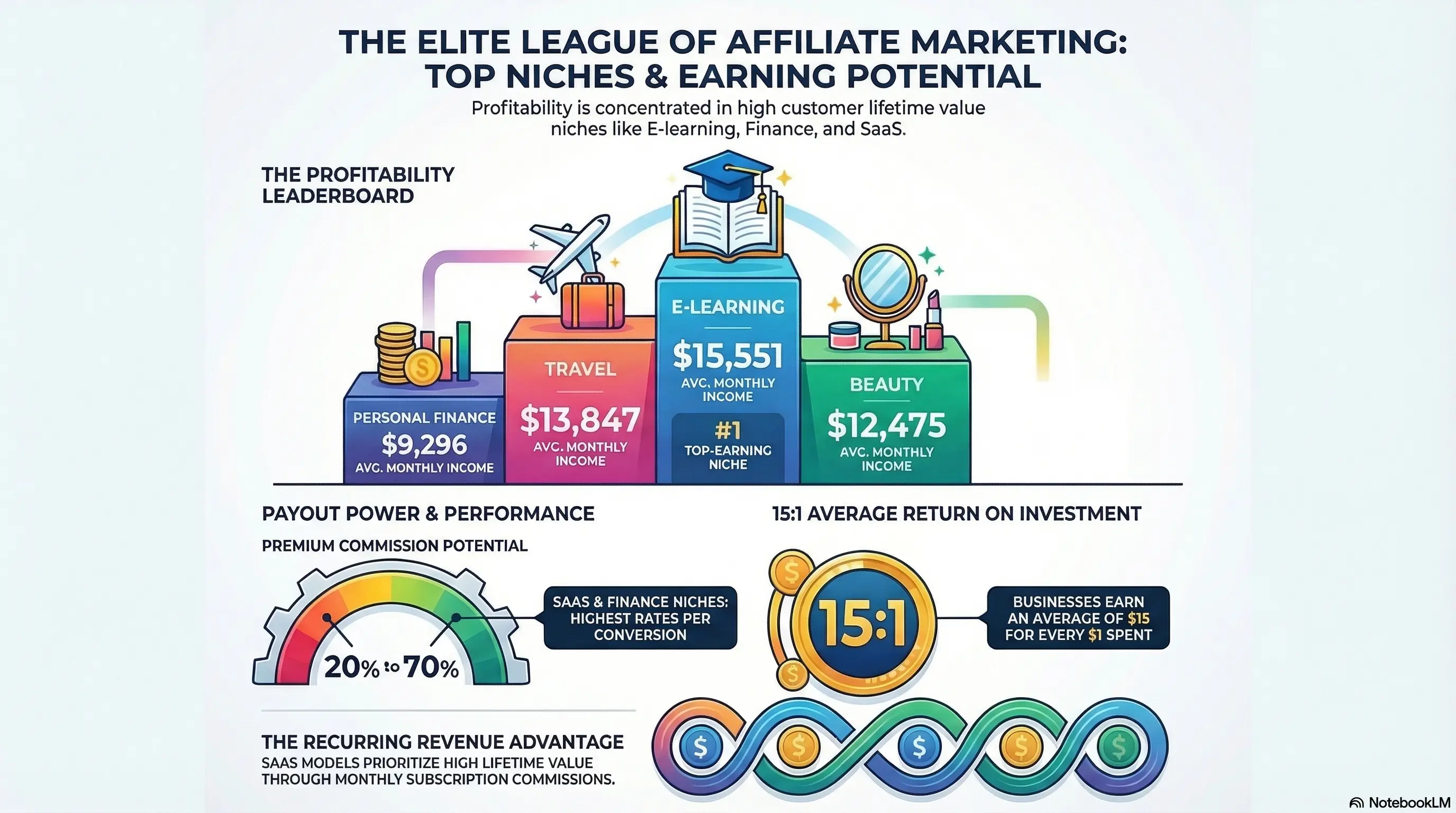
- Check the "Big Three" Fertility: Does your problem fall into E-Learning, Travel, or Finance? These sectors consistently outperform others because they offer a direct ROI or high-impact value. (For context: E-learning affiliates average $15k/mo, while Pet Care averages $920/mo).
- Define Your "10/10" Client: Who is the person most likely to succeed with your advice? I target people who already have some success and value impact over just "saving money." It’s much easier to help someone who is already moving.
- Draft Your Mission Statement: Fill in this blank: "We make it nearly impossible to fail at [Result] for [Type of Person]."
Mistakes to Avoid
- Targeting the "Chronic Seeker": Don't build for people who just want a "free hack." They will waste your time and never implement your advice. Target the person who is ready to invest in a result.
- Vague Positioning: "Bringing happiness" is not a business. "Helping agency owners scale to $20k/mo with better funnel tracking" is a business.
- Competing on Price: If you are the cheapest, you are a commodity. I compete on access and results.
Quick Recap and Next Action
People fail because they lose belief in their plan. By selecting a fertile niche and a problem you actually care about, you create the emotional momentum needed to stay in the game long enough to win.
Your next action: Pick one of your three problems from Step 1. Today, write out your "Mission Statement" using the formula above. If it doesn't feel like something you could say with confidence to a friend, keep refining it.
If this guide helped you get started or gave you a framework you've used, a tip helps keep it free.
Support the WorkNo PayPal account needed.