Answer engine optimization for affiliate marketers
Ryan Mercer·
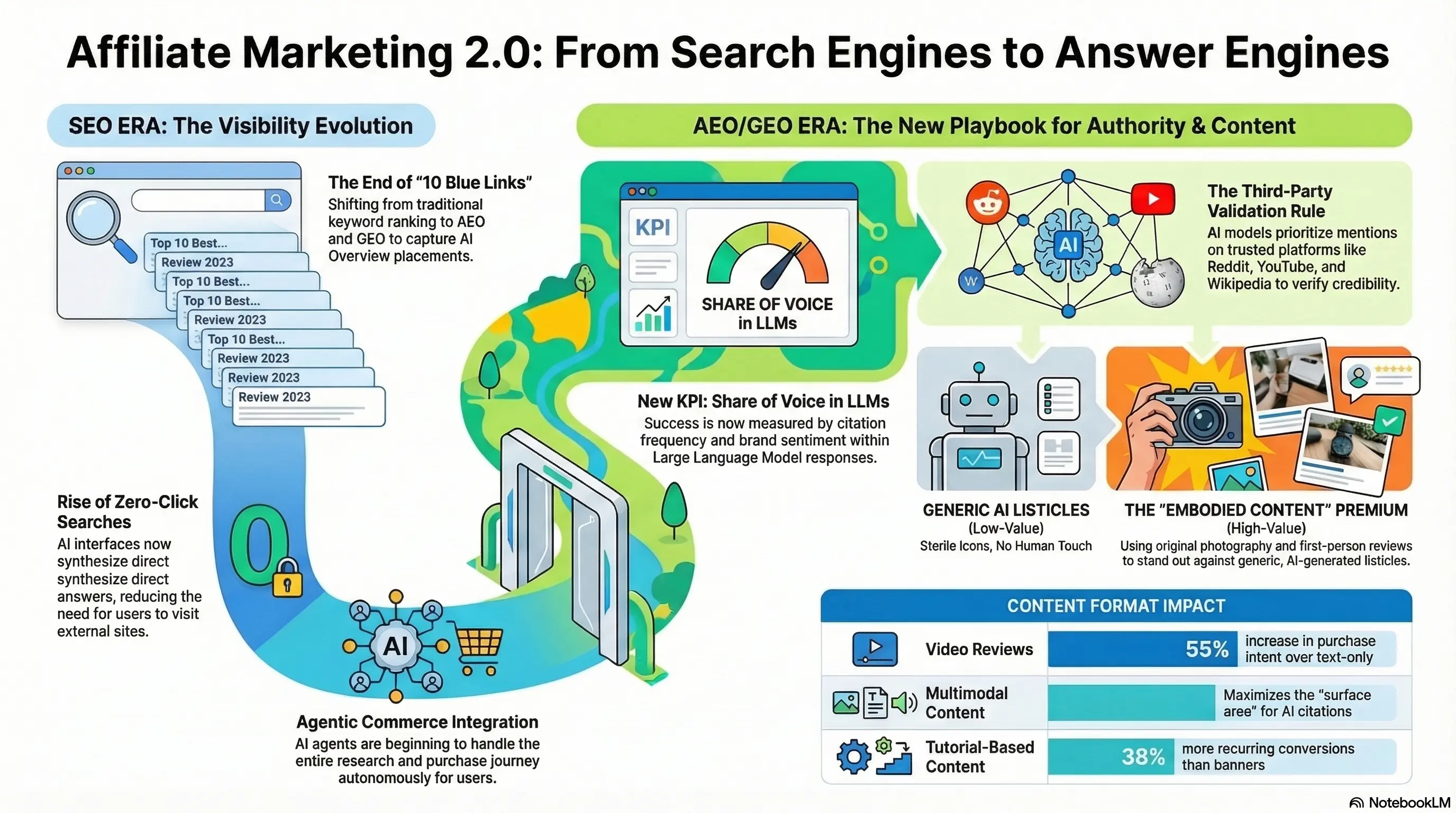
Search has always been the primary traffic source for affiliate publishers. So when search behavior shifts, affiliate income shifts with it. The shift happening right now is significant: AI-generated answers are consuming a growing share of queries that used to produce clicks.
That's not a prediction anymore. It's measurable in Search Console for anyone running a content-heavy site.
The question worth asking is not whether this is happening. It's which types of content and which affiliate strategies hold up under these conditions, and which ones don't.
What actually changed
The traditional affiliate content model was built on a straightforward mechanic: someone types a query into Google, your article appears in the top results, they click through, they read your recommendation, they follow your affiliate link.
That mechanic still works, but for a narrower slice of queries than it used to.
AI Overviews now handle a substantial portion of informational queries directly on the results page. "What is affiliate marketing" doesn't need a click anymore. Neither does "how does a cookie window work" or "what are the best niches for affiliate income." Google synthesizes an answer, cites a few sources for credibility, and most users don't leave the page.
The queries being consumed are almost entirely informational. Definitions. Explanations. How-it-works content.
What isn't being consumed at the same rate: commercial intent queries. Comparison pages. Best-of roundups. Specific product reviews. Pricing and alternatives content. AI Overviews don't confidently make buying recommendations at scale. They synthesize facts but stay cautious about endorsements.
That distinction matters a lot for how you allocate your publishing effort.
Which content still earns clicks
The content that still drives clicks from search falls into a few clear patterns.
Specific comparisons: "X vs Y" queries still produce clicks because users want the full breakdown, not a summary. AI Overviews often won't pick a winner.
Long-tail transactional queries: "Best [product type] for [specific situation]" tends to send traffic because the user has a defined need and trusts a full article over a synthesized fragment.
Pricing and updated information: AI answers are trained on historical data. Queries about current pricing, recent product changes, or active discount codes still route to publishers who maintain up-to-date pages.
First-person experience content: AI can't replicate a first-person review. "I used this tool for six months" still earns engagement because readers recognize its authenticity, and AI Overviews tend not to paraphrase first-person accounts accurately.
High-consideration decisions: Software for teams, financial products, health-related tools. Anything where the stakes are high enough that a reader won't trust a four-sentence summary. These users want detail.
That list also tells you what's declining as an affiliate traffic source: generic how-it-works articles, basic definition pages, broad overview content that summarizes publicly available information. The SEO investment in those pages doesn't pay back the way it used to.
Being cited by AI answers
Here's the part most affiliates miss: getting absorbed by an AI Overview is not always a loss.
If your content gets cited as a source in an AI-generated answer, you still receive a subset of clicks — from users who want to verify the source or get more depth. That traffic is smaller in volume but tends to have higher intent. The person who clicks through from an AI citation is already oriented toward the topic.
To be cited consistently, the content needs to meet a few conditions.
It needs to be specific. Vague or heavily hedged content doesn't get cited. Concrete claims with clear scope — "in programs with 30-day cookie windows, the mobile attribution gap tends to run 15 to 25 percent" — are more likely to be pulled than generic advice framed as universal truth.
It needs to come from a trusted source. Sites with established authority, named authors, and clear editorial standards get cited more than anonymous content farms. Your author page, your disclosure practices, and your About page all contribute to this signal.
It needs structured content. AI systems parse clearly structured articles more easily than walls of prose. Short, well-labeled sections with descriptive headings make the content extractable.
None of this is different from good editorial practice. But it's worth recognizing that citation visibility is a real distribution channel now, not just a byproduct.
Building presence outside of search
The affiliate marketers I've watched hold their income through the AI search disruption share one common trait: they weren't entirely dependent on Google organic.
They had built distribution in places where AI can't easily synthesize their content. That usually means YouTube, Reddit threads, or email lists.
First-person video and photo content is the most durable format in this environment. If you physically tested a product, got on camera, posted the footage — that content isn't something an AI can replicate. It's also exactly what a skeptical buyer wants when deciding whether to trust a recommendation.
Reddit has become a significant source of affiliate-adjacent traffic. Not through paid placements or link-drops, but because users searching for real opinions are increasingly appending "reddit" to their queries. Sites that have built genuine participation in relevant subreddits are capturing this traffic without it passing through Google at all.
None of this means abandoning SEO. It means not treating SEO as the only channel.
What affiliate structures hold up
The economics of your affiliate income matter here too.
If most of your revenue comes from high-volume informational content monetized with display ads or low-ticket affiliate links, the AI Overview shift hits directly. That content type is what's being replaced.
If most of your revenue comes from commercial comparison content, direct product recommendations, and higher-ticket programs with longer commission structures, the transition is less damaging. That content still earns clicks, and the affiliate economics are stronger per visitor even when volume drops.
This isn't an argument for abandoning informational content entirely. It can still function as audience-building and can earn citation visibility. But treating it as a primary revenue engine through generic affiliate links is a weaker position than it was two years ago.
The publishers building toward 2027 treat their informational content as a trust layer and their commercial content as the actual monetization engine. That distinction used to matter less. Now it's often the difference between a site that's holding steady and one that's watching traffic erode one algorithm update at a time.
Mistakes to avoid
Building around content AI can fully replace: If Google can summarize your article accurately in four sentences, that article is not a durable traffic source. That doesn't mean deleting it. It means not treating it as a revenue engine.
Treating AI Overviews as purely negative: Being cited as a source is still distribution. Many publishers haven't realized their traffic dropped because they were being summarized rather than bypassed. Those are different problems with different solutions.
Abandoning SEO for hype-driven alternatives: The "SEO is dead" cycle repeats every few years. The actual answer is almost always "SEO evolved." Organic search still drives significant affiliate revenue — it just rewards different content now than it did before.
Relying on a single distribution channel: Publishers with email lists, YouTube presence, or Reddit credibility weathered the 2024 and 2025 algorithm shifts noticeably better than those running entirely on organic Google traffic.
Optimizing for AI summarization at the expense of human readers: Some publishers are restructuring content to be more "AI-readable." That's not wrong, but readers come first. If the content is genuinely useful and clearly structured, it serves both audiences.
Quick recap
AI Overviews are absorbing informational queries at scale, which is reducing click-through rates on definition pages, explainers, and broad how-it-works content.
Commercial intent content is still driving clicks: comparisons, specific product reviews, pricing pages, high-consideration decisions. AI answers aren't replacing that function yet.
Publishers holding their ground have diversified away from pure SEO dependency. Video, Reddit, email, and community presence are all distribution channels that AI can't absorb.
Being cited in AI answers is a real traffic source, even if it's smaller than traditional organic. Specific, structured, credible content earns citations more reliably than vague or generic coverage.
The affiliate structure that holds up: less reliance on high-volume informational traffic, more reliance on commercial intent pages and direct audience relationships.
One concrete step worth taking: open Search Console and look at the click-through rate trend on your top informational pages over the past 12 months. If impressions are holding but clicks are falling, you're watching AI Overview absorption in your own data. That's your map.
If this guide helped you get started or gave you a framework you've used, a tip helps keep it free.
Support the WorkNo PayPal account needed.