Affiliate SEO Survival Ratio
Ryan Mercer·
The Survival Ratio: Why 65% Is the Magic Number for Affiliate SEO in the AI Era
The Affiliate Shakeup That Already Happened
The review farm model is over. As search algorithms pivot toward high-utility, brand-led ecosystems, the traditional content-volume play has been systematically dismantled by recent Google core updates. What remains is worth studying.
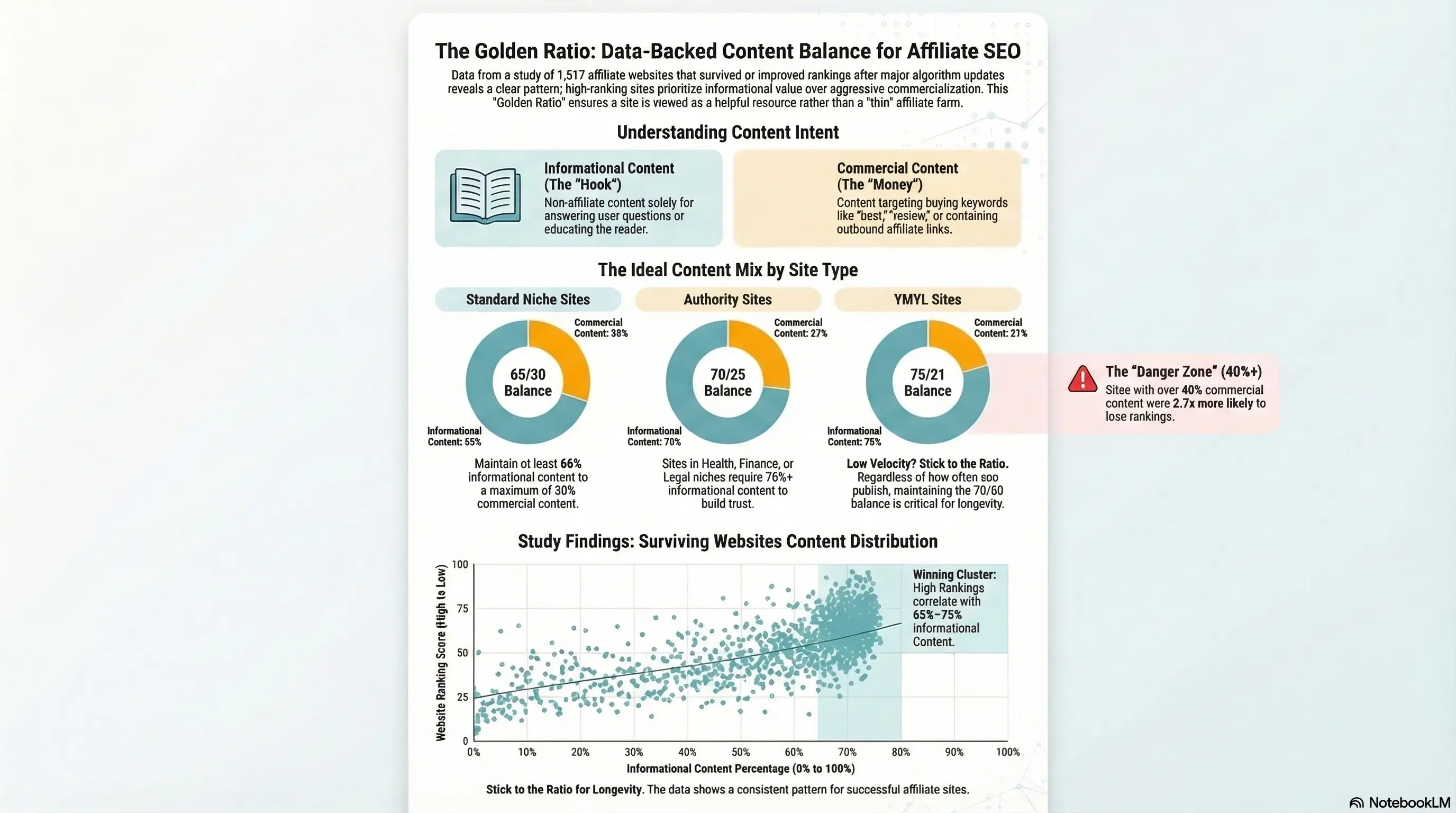
We analyzed data from 1,517 surviving affiliate websites — sites that not only weathered the updates but are actively scaling. The findings suggest that longevity in the AI era isn't a matter of luck or sheer backlink volume. It's governed by a specific ratio: a precise balance of informational to commercial content. For the performance marketer, this ratio is the primary defense against algorithm volatility and the erosion of search real estate by generative AI.
The 65/30 Ratio: Why Informational Content Is Non-Negotiable
Data from resilient niche sites reveals a clear threshold: survivors maintain a minimum of 65% informational content and a maximum of 30% commercial content. This isn't a suggestion; it's a structural requirement for topical authority.
The ratio works because it shifts the site's objective from selling to helping. In a post-SGE environment, Google prioritizes entities that satisfy deep informational intent. Detailed guides and tutorials build a trust buffer. That buffer means that when an algorithm update targets thin affiliate content, your site gets classified as an educational resource rather than a low-value intermediary.
Every informational post acts as a top-of-funnel asset that earns the right to present a commercial offer later in the user journey.
YMYL Sites: 70% Is the Floor for Health and Finance
In "Your Money, Your Life" (YMYL) sectors, the trust requirements are higher. For health, finance, and e-learning sites, the informational threshold needs to exceed 70%. The stakes are reflected in the earnings data:
- E-learning affiliates average $15,551 per month.
- Finance affiliates generate $9,296 per month.
To compete at this level, a website has to do more than aggregate links; it has to demonstrate elite E-E-A-T (Experience, Expertise, Authoritativeness, and Trustworthiness).
Compliance as a ranking signal
High-earning sites in 2026 treat legal transparency as a feature, not a formality. FTC (U.S.) and CMA (UK) regulations require "clear and conspicuous" disclosures. Disclosures must be unavoidable, understandable, and unambiguous. Failing to meet these standards doesn't just invite regulatory fines; it creates a trust deficit that keeps a site out of the top tier permanently.
Beyond the Blog: Repositioning as a Real Business
The fundamental shift in surviving models is the transition from "content blog" to services website with a thorough blog section. Service positioning is the primary defense against being flagged as an AI content farm.
To build a resilient brand infrastructure:
- Google Business Profile verification: A verified physical presence with NAP (Name, Address, Phone) consistency signals legitimacy to search engines.
- Educational positioning: Move from product reviews to educational infrastructure. Solve complex problems rather than listing product features.
- Revenue diversification: Incorporating a service or digital product — consultations, coaching, or software — moves your business model away from 100% dependency on third-party commissions.
Positioning as a real brand with a physical or consultation footprint gives you a level of algorithmic durability that anonymous affiliate sites lack.
Quality Over Volume: The Infrastructure Affiliate Model
Chasing low-ticket gadget sales for 2% commissions is a failing strategy. With the global market projected to hit $20 billion by 2026 and a 15.2% CAGR, the wealth is concentrating at the top.
Performance data shows that affiliate programs deliver an average ROI of $12-15 for every $1 spent (1200-1500% ROAS) when high-ticket infrastructure is the focus, not commodity products.
Promoting infrastructure tools like Funnelish is more valuable than promoting one-off products because these tools handle the checkout and revenue heartbeat of a user's business. Once a user integrates their revenue collection into a platform, churn drops significantly. Strong EPC and predictable Net-30 cash flow follow from 35% recurring lifetime commissions.
As sales strategist Bryan Harris put it:
"You don't need to make any more content... You need more access and more perks. That's the thing that people pay exponentially more for."
Bryan Harris
The AI Factor: Automating the Drudgery, Not the Trust
AI has destroyed the low-effort affiliate model, but it has made infrastructure affiliates more efficient. 79% of affiliates now use AI-driven tools, but the survivors use them to handle drudgery while humans maintain brand trust.
What's working now:
- Bulk service templates: Using AI to generate service page templates (for example, "Book Service in Location") to capture local search intent.
- Niche validation via Ahrefs: Validating potential through question-clusters. A target niche should have a combined search volume of at least 50,000 queries.
- Mobile-first optimization: With 62% of traffic and 70% of conversions occurring on mobile and tablet devices, your infrastructure has to be optimized for mobile first.
- GMB as defense: A verified GMB profile remains the most effective way to separate a real business from a mass-produced AI content site in the eyes of the search algorithm.
Summary: Future-Proofing the Affiliate Engine
The affiliate marketing industry is growing, but it's also maturing. The 65/30 ratio is your baseline for entry. The goal is to evolve beyond the link and become an infrastructure affiliate.
With 95% of beginners failing within their first year, success belongs to those who build sticky revenue models and brand-led authority. The top 10% of affiliates drive 90% of all revenue. To get there, stop building for the algorithm and start building for the reader.
Mistakes to Avoid
- Padding your informational content count with thin how-to posts that don't actually help anyone. The ratio matters because the content matters; gaming the ratio without improving the content changes nothing.
- Adding a GMB profile without a real service offering behind it. Google classifies you as a local business; you need to be one.
- Treating informational content as non-commercial by default. A good how-to post can still earn its keep if the problem it solves points naturally to a paid solution.
Quick Recap and Next Action
The 65/30 ratio is a floor, not a formula. Google rewards sites that help before they sell. So do readers.
If you only change one thing this week, look at your last five informational posts and ask whether a reader who had never heard of your site would trust them. If not, you're missing the trust buffer that makes the ratio matter.
If this guide helped you get started or gave you a framework you've used, a tip helps keep it free.
Support the WorkNo PayPal account needed.
More from this topic
Outrank AI Overviews
How to structure affiliate content that still earns clicks after Google AI Overviews absorb informational queries: formats, page positioning, and intent targeting.
The Passive Link Is Dead
Why passive affiliate link strategies are failing in 2026, and what active promotion, community-led distribution, and direct audience relationships look like instead.
SEO and Digital Visibility
SEO and digital visibility in 2026: why search traffic and business value are diverging, and how affiliate content must evolve to stay connected to buyer intent.
Answer engine optimization for affiliate marketers
How affiliate marketers can adapt to answer engines as AI Overviews and ChatGPT replace traditional search clicks with synthesized responses — and still earn commissions.