Affiliate Blueprint 2026
Ryan Mercer·
The 2026 affiliate blueprint: infrastructure over content
The "Top 10 Best Products" model is over. Not struggling — over.
When anyone can generate ten thousand product reviews in an afternoon, content volume stops being a competitive edge. The affiliates still building durable income in 2026 are not out-publishing anyone. They are out-infrastructuring them.
This is not a prediction. I watched the shift happen in my own portfolio. Content I had built for informational intent started getting absorbed into AI Overviews. Revenue dropped on those pages, sometimes by half, while pages targeting decision-making intent — comparison guides, migration walkthroughs, implementation tutorials — held. In some cases they grew. The difference was intent stage, not quality or word count.
Why content is no longer a moat
AI did not just make content cheaper. It made undifferentiated content worthless.
A review blog built on generic product comparisons has no defensible edge when a language model can synthesize every review ever written in seconds. The only content AI cannot replicate is content that requires real-world contact: an actual login, a broken workflow, a refund experience, an account rep's response to a complaint.
That kind of contact is what builds trust. And trust is what converts.
The implication is not "stop publishing." It is "publish only what requires genuine experience to produce."
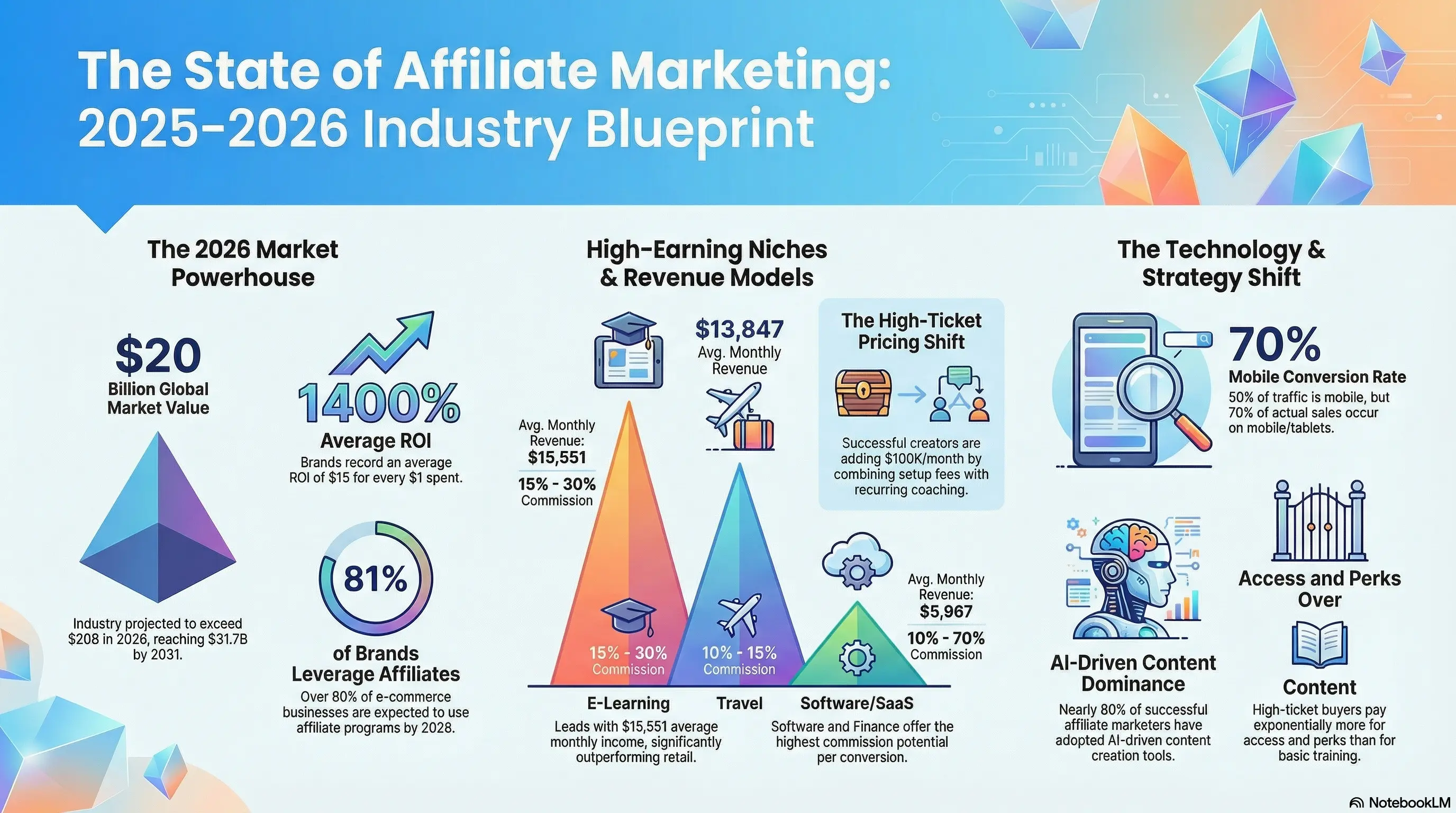
What infrastructure affiliate marketing actually is
Infrastructure affiliate marketing means promoting the software that runs the operational core of a business: checkout systems, CRM tools, funnel builders, email platforms. Not products a user buys and forgets. Products a business builds around.
The economics are different from traditional affiliate work. Users who integrate infrastructure software rarely switch — the cost of migration is too high. Commission structures tend to be recurring, often 35–70% lifetime, because the business model supports it. At 100 to 200 active referrals on a recurring lifetime commission, the math toward a $5,000 monthly revenue target looks completely different than it does at a 4% commission on a $50 product.
I have had infrastructure referrals still paying commission 18 months after the tutorial was published. That does not happen with gadget reviews.
Speed is a financial metric, not a technical one
For anyone building or recommending checkout infrastructure, page speed is not a UX concern. It is a revenue variable.
Ad algorithms on TikTok and Meta penalize slow destinations with higher CPMs and reduced distribution. A three-second page load is measurable ad spend waste — not an abstraction, but a direct cost. Fast checkout infrastructure compresses customer acquisition cost. That is a concrete selling point when you are positioning an infrastructure tool to an agency or operator.
This means your content should lead with the economic argument, not the feature list. The feature that matters is the one that shows up in the numbers.
International traffic is still underused
25% of affiliate transactions are now cross-border. Most affiliates are still building USD-only funnels, which means most of them are dropping international conversions they are technically driving.
Setups that detect a visitor's location and serve localized currency, language, and payment methods capture traffic that otherwise bounces at checkout. Markets like Brazil (Pix), Netherlands (iDEAL), and parts of Europe (Klarna) have payment preferences that require native integrations to convert. This is one of the clearest arbitrage opportunities still available: international traffic on many channels is cheaper than US traffic, and the conversion problem is a solvable technical one, not a content problem.
The tutorial model is still the best channel for software
Tutorial-style content converts software offers at meaningfully higher rates than review-style content because it attracts viewers who have already decided to try the product. I cover this in more detail in the teaching-not-selling piece, but the short version: the viewer who clicks through a tutorial has already decided to try, not just evaluate.
The most effective approach I know for software is the implementation package — share a real funnel design or workflow template alongside the tutorial so the viewer can import and start using it immediately. This collapses the time from "interested" to "active user," which matters for recurring commission because users who get to implementation faster tend to stay on the platform longer.
One practical note on attribution: software offers convert days or weeks after the initial view. A 30-day cookie window is the minimum worth building around. I have walked away from otherwise solid recurring commissions because a 24-hour attribution window made the economics unworkable for the content format I was running.
Agency outreach as the high-ticket path
One agency relationship that migrates their full client roster to a platform you are promoting can generate more recurring commission than dozens of individual sign-ups.
The pitch changes at this level. You are not selling a tool — you are offering a better infrastructure model. Agency-level deals are about access and risk reversal, not feature comparisons. The most effective positioning I have seen is: "Here is the infrastructure my clients are running on, here is why it outperforms the patched-together alternative, and here is how to test it without risk."
This is not a year-one play. Getting to this kind of relationship requires an established track record and real-world evidence. But it is worth planning toward from the beginning.
Compliance as a competitive filter
FTC, EU DSA, and UK CMA requirements on affiliate disclosures are tightening. Beyond the compliance case, being documented and proactive about disclosure is now a filter for better program access.
Premium programs increasingly require compliance documentation before approving high-volume affiliates. Brands are offboarding affiliates who create legal exposure. If you are compliance-first and can demonstrate it, you are competing in a narrower field.
I think of compliance as a credential rather than an obligation. It costs nothing to get right and it narrows the competitive set.
Mistakes to avoid
- Building around content volume when your niche is reachable by AI. The defense is contact, not quantity.
- Choosing infrastructure offers based on commission rate alone. Stickiness and payout history matter more over 12 months.
- Promoting offers with short attribution windows if your content format has a long decision cycle. The economics only work if the cookie window matches how your audience actually behaves.
- Treating agency outreach as a shortcut before you have a track record. Build the referral history first.
Quick recap and next action
The 2026 affiliate model that holds is infrastructure products, recurring commissions, tutorial-style content that requires genuine product experience, and compliance as a credential rather than a cost.
If you only change one thing this week, look at your primary offer and check whether it has a recurring commission structure and a 30-day minimum attribution window. If it does not, find a comparable offer that does. The math difference over 12 months is significant.
If this guide helped you get started or gave you a framework you've used, a tip helps keep it free.
Support the WorkNo PayPal account needed.
More from this topic
Affiliate Business from Scratch
How to build an affiliate business from scratch in 2026. Covers offer selection, tracking setup, and your first 90-day action plan.
Beyond the Amazon trap
Why low-ticket Amazon affiliate commissions are a revenue treadmill — and how to exit toward recurring, high-ticket, and direct partnership income that scales.
Niche Selection Framework
A field-tested framework for picking a niche you can actually stick with for 20 years while building a high-ticket business.
Affiliate Marketing Primer
How affiliate marketing works, what separates durable operators from people who quit, and where to start if you're building this as a real business.